
It is one of the first questions people ask when they start looking into dental implants. The surgery itself can be relatively brief, but the full treatment process is something quite different. Dental implant treatment unfolds across several stages, and the total time from first consultation to fitted crown spans months rather than days for most patients.
Understanding what each stage involves and what influences the timeline helps you plan ahead and set realistic expectations before you begin. The overall duration of dental implant treatment depends on individual factors that are assessed before any procedure is planned.
Quick Overview
- A dental implant procedure refers to the full treatment journey from initial assessment to the placement of the final crown, not just the surgical appointment.
- It may take anywhere from three months to over a year, with the timeline varying significantly between patients.
- It involves multiple appointments across distinct stages, each of which has its own healing period and requirements.
- How long each stage takes depends on bone condition, overall health, whether preparatory procedures are needed, and how the body heals.
Keep reading to understand each stage of the process and what affects the overall timeline for most patients.
What Happens at Each Stage of the Dental Implant Process?
A dental implant procedure is not a single appointment. It is a staged treatment that typically involves four to five key phases, each building on the one before it.
Stage 1: Consultation and assessment. The first appointment involves a dental examination, X-rays, and in many cases, 3D imaging of the jaw. Your dentist will assess the health of your gums, the density and volume of your jawbone, and your overall medical history. Implant treatment unfolds in stages, and this initial planning appointment is where the full timeline begins to take shape.
Stage 2: Preparatory procedures (if needed). Not everyone moves directly to implant placement. If a tooth needs to be extracted first, or if there is insufficient bone to support the implant, preparatory work is carried out. Bone grafting, for example, adds bone material to rebuild the jaw and requires a healing period before the implant can be placed. This stage is what most commonly extends the overall timeline.
Stage 3: Implant placement. The surgical appointment involves placing a titanium post into the jawbone under local anaesthetic. Most patients find the experience more manageable than they expected. After placement, the site is left to heal.
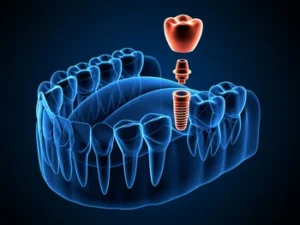
Stage 4: Osseointegration. This is the healing phase during which the bone gradually grows around and bonds to the implant post, a process called osseointegration. It is the stage that takes the most time and is one of the main reasons dental implant treatment spans months. Titanium allows bone to grow around implants, and this integration period typically takes several months. During this time, patients are generally advised to continue eating soft foods and maintaining careful oral hygiene around the implant site to support the healing process.
Stage 5: Abutment fitting and crown placement. Once osseointegration is confirmed, the abutment is attached to connect the implant to the final crown. The crown itself is custom-made at a dental laboratory from impressions or digital scans of your teeth. This final fitting stage takes one to two appointments and completes the restoration.
How Long Does Each Stage Take?
Each stage has its own typical duration, though all timelines are approximate and vary between patients.
 The initial consultation and any preparatory procedures take one to several appointments spread over days to weeks. If bone grafting is needed, the preparatory phase alone can add three to six months to the timeline before implant placement even begins.
The implant surgery is typically a single appointment. As noted, the procedure may take between 30 minutes and a couple of hours, though this varies with the number of implants being placed and the complexity of the case.
Osseointegration is the longest phase. For most patients, this takes between three and six months. During this period, the implant is stable, but the bone is still completing its bonding process. Placing the final crown before osseointegration is complete risks the stability of the implant, which is why this stage is not rushed.
The abutment and crown fitting generally takes one to two weeks from impressions to final placement once the healing period is over.
For a patient with no complications and adequate bone, the total timeline from first consultation to final crown is often between three and six months. For patients who need bone grafting or other preparatory work, the process is more commonly in the range of nine to twelve months or longer.
What Factors Affect How Long the Process Takes?
Several individual factors can shorten or extend the overall timeline. Understanding them helps you set realistic expectations before treatment begins.
Bone density and volume are among the most significant. Where there is adequate bone, the implant can be placed and allowed to heal without additional procedures. Where bone loss has occurred, grafting is needed, and the timeline extends considerably.
Overall health and healing capacity vary between patients. Conditions that affect the immune system, bone metabolism, or blood supply to the tissues can slow healing at any stage of the process. Certain medications may also be relevant. Your dentist will review your medical history during the consultation.
Smoking consistently affects healing timelines. Nicotine reduces blood flow to the gum and bone, which impairs the body’s ability to form new bone around the implant during osseointegration. Patients who smoke are typically advised to discuss this before treatment begins, as it affects planning and aftercare.
The number of implants being placed increases surgical complexity and may affect the overall timeline, particularly if multiple sites need to heal simultaneously. Patients replacing several adjacent teeth with a bridge supported by implants will follow a similar staged process, but the initial procedure takes longer, and the healing demands are spread across multiple implant sites.
The position of the missing tooth also matters. Implants in the upper back jaw sit near the sinus cavity, which may require a sinus lift procedure before placement. This adds time to the process in the same way that bone grafting does.
Dental implants and the factors affecting them are closely connected to the health of the surrounding bone and tissue, which is why the assessment stage is critical for planning an accurate timeline.
Taking the Next Step
 The total time a dental implant procedure takes depends on your individual situation, and there is no single answer that applies to every patient. The only way to understand what your specific timeline looks like is through a proper clinical assessment with imaging. What matters most is that each stage is given enough time to complete properly, as the long-term stability of the implant depends on it.
If you have questions or would like to understand what the process might involve in your case, the team at Dental 266 is here to help. You can book an appointment online or call us on 02 9051 0600.
Note: Any surgical or invasive procedure carries risks. Before proceeding, you should seek a second opinion from an appropriately qualified health practitioner.
Frequently Asked Questions
How long is the actual implant surgery itself?
The surgical placement of a single dental implant typically takes between 30 minutes and two hours. The time varies depending on the complexity of the case, the position of the tooth being replaced, and whether any additional steps are needed during the same appointment. It is important to distinguish the surgery time from the full treatment timeline, which spans several months.
Can I have a temporary tooth while the implant heals?
In many cases, yes. A temporary restoration can be provided to maintain appearance and function during the healing period, particularly for implants in visible areas. Not everyone requires one, and suitability depends on the position of the implant, the stability of the implant post, and your dentist’s assessment of the site after placement.
References
Healthdirect Australia. (n.d.). ‘Dental implant’. Healthdirect Australia. Canberra, ACT: Australian Government. https://www.healthdirect.gov.au/dental-implant
Better Health Channel. (n.d.). ‘Dental treatment’. Better Health Channel. Melbourne, VIC: Victorian Government Department of Health. https://www.betterhealth.vic.gov.au/health/conditionsandtreatments/dental-treatment
Teeth.org.au. (n.d.). ‘Dental Implants’. Teeth.org.au. Australia: Australian and New Zealand Academy of Periodontists. https://www.teeth.org.au/dental-implants