
When several teeth are missing in a row, the options for replacing them tend to raise more questions than a single missing tooth. A dental implant bridge is one approach that combines the stability of implants with the coverage of a bridge, but understanding how it works, who it suits, and how it compares to other choices takes a little more than a quick explanation.
Whether you are weighing up treatment options after a tooth extraction or planning ahead for multiple missing teeth, knowing the key differences between a dental implant bridge and other replacements is a practical starting point for the conversation with your dentist.
Quick Overview
- A dental implant bridge uses two or more implants to support a fixed row of replacement teeth, without relying on natural teeth on either side of the gap.
- It may suit people with multiple adjacent missing teeth who have sufficient bone density to support implant placement.
- It may involve implant surgery, a healing period, and the fitting of a custom bridge, with the exact process varying by case.
- Outcomes can be influenced by bone quality, overall health, oral hygiene, and how many teeth need to be replaced.
- A thorough assessment including imaging is generally needed to determine whether this approach is appropriate.
Keep reading to understand how a dental implant bridge works, how it differs from a traditional bridge, and what the treatment process generally involves.
What Is a Dental Implant Bridge?
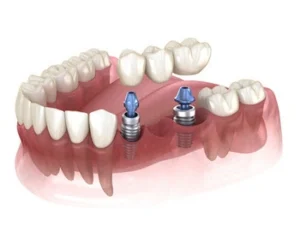
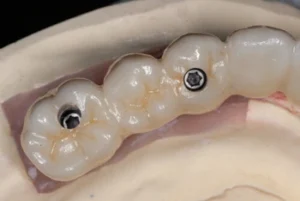 A dental implant bridge is a fixed tooth replacement that spans a gap of two or more missing teeth. Unlike a traditional dental bridge, which anchors to the natural teeth on either side of the gap, an implant-supported bridge is held in place by titanium implant posts placed directly into the jawbone.
The bridge itself, a row of prosthetic teeth, is then attached to these implant posts. Because the bridge is supported by implants rather than existing teeth, the natural teeth on either side of the gap do not need to be modified or crowned to hold it in place. This is one of the key structural differences between implant-supported and traditional bridgework.
The number of implants used depends on how many teeth are being replaced and the distribution of the load across the jaw. In many cases, two implants are sufficient to support a bridge of three or four teeth. Larger spans may require additional implants for stability.
How Does a Dental Implant Bridge Differ from a Traditional Bridge?
A traditional dental bridge works by anchoring a false tooth to the natural teeth on either side of the gap. Those neighbouring teeth are prepared by having enamel removed so that crowns can be placed over them. The false tooth, called a pontic, hangs between these two crowned teeth.
A dental bridge replaces missing teeth by bridging the gap with a fixed restoration attached to the surrounding teeth. While this approach works well in many situations, it does involve altering healthy teeth to create the anchor points.
An implant-supported bridge avoids this by using the jawbone itself as the foundation. The implants act as artificial tooth roots, meaning no preparation of adjacent natural teeth is required. It also means the jawbone continues to receive stimulation from the implants during chewing, which helps preserve bone density in the area over time. A traditional bridge does not replicate this root-level stimulation, so bone loss beneath the bridge can occur gradually.
Who May Be Suitable for a Dental Implant Bridge?
Not everyone is a candidate for an implant-supported bridge, and suitability is determined through a comprehensive clinical assessment.
Adequate bone density and volume at the implant sites are important. The jawbone needs to be able to support the implant posts securely. Where significant bone loss has already occurred, bone grafting may be recommended first to rebuild the necessary structure before implants can be placed.
Overall health matters too. Conditions that affect healing, bone metabolism, or immune function may require additional planning before treatment can proceed. Gum health is also assessed, as active gum disease needs to be treated before any implant procedure.
Implant-supported bridges and bone health are closely connected because bone loss tends to accelerate after tooth loss, and the sooner treatment is considered, the more bone is typically available to work with.
Age and lifestyle factors, including smoking, are also considered. Smoking reduces blood flow to the gum and bone tissue, which can affect how reliably the bone integrates around an implant. Patients who smoke are typically advised to discuss this openly with their dentist before treatment begins, as it is a factor that influences both planning and the approach to aftercare.
What Does the Treatment Process Generally Involve?
The process of getting a dental implant bridge typically unfolds over several months, though timelines vary between patients depending on individual circumstances.
The first stage involves an assessment and treatment planning. This usually includes X-rays or 3D imaging to evaluate bone volume, the position of the nerves, and the overall structure of the jaw. A treatment plan is developed based on these findings.
If bone grafting is needed, this is carried out before implant placement and requires a healing period of several months before the next stage can proceed.
Implant placement involves the titanium posts being placed into the jawbone under local anaesthetic. A healing period then follows, during which osseointegration takes place. This is the process by which the bone gradually grows around and bonds to the implant posts, creating a stable foundation for the bridge. Osseointegration and implant stability are closely related; the success of the osseointegration phase directly determines whether the implant can support the bridge long term.
Once osseointegration is confirmed, the abutments are attached to the implant posts and impressions or digital scans are taken to create the final bridge. The bridge is custom-made in a dental laboratory and fitted at the final appointment.
A temporary bridge may be provided during the healing phase to maintain appearance and function while the permanent restoration is being prepared.
How Do You Care for a Dental Implant Bridge?
 A dental implant bridge requires regular care to maintain the health of the surrounding gum and bone tissue. While the prosthetic teeth themselves cannot develop decay, the gum tissue and bone around the implants can still be affected by bacterial buildup if cleaning is neglected. Peri-implantitis, an inflammatory condition affecting the tissue around the implant, is one of the more common long-term complications and is largely preventable with consistent oral hygiene.
Brushing twice daily is important, as is cleaning beneath and around the bridge. Because the bridge spans multiple teeth, floss cannot pass between the individual units in the usual way. Interdental brushes or a water flosser designed for implants can help clean underneath the bridge and around the gum line effectively. Cleaning around implant-supported bridges is an important part of maintaining peri-implant health over time, and regular professional check-ups allow the dentist to monitor the tissue and catch early signs of inflammation.
How Does an Implant Bridge Compare to Other Tooth Replacement Options?
When multiple teeth are missing, the main alternatives to an implant-supported bridge are a traditional bridge and a partial denture.
A traditional bridge is faster and does not involve surgery, which makes it suitable in some situations. The trade-offs include the need to modify adjacent healthy teeth and the gradual bone loss that occurs beneath the bridge over time.
A partial denture is removable and typically the least invasive option. It can replace multiple missing teeth across the arch and tends to involve less upfront cost. However, it does not prevent bone loss, may feel less stable during eating and speaking, and requires removal for cleaning.
A dental implant bridge offers a fixed, stable solution that preserves the jawbone and does not require modification of healthy adjacent teeth. The upfront cost is typically higher than a traditional bridge or partial denture, and the process takes longer due to the healing period involved. For patients with sufficient bone and good general health, it may offer strong long-term value compared to alternatives that may need replacing or adjusting over time as the underlying bone changes.
The most appropriate option depends on the number of missing teeth, the condition of the surrounding bone and gum, individual health factors, and personal priorities. A personalised treatment plan, developed after a thorough assessment, is what guides the decision. There is no universal answer, which is why a detailed consultation with imaging is always the starting point.
Taking the Next Step
If you are missing multiple teeth and want to understand whether a dental implant bridge may be a suitable option, the first step is a proper assessment that accounts for your bone structure, gum health, and overall oral health. There is no single answer that fits every patient, and a clinical examination with imaging provides the clearest picture of what is realistic for your situation.
The team at Dental 266 in Burwood is available to answer your questions and talk through your options. You can book an appointment online or call us on 02 9051 0600.
Note: Any surgical or invasive procedure carries risks. Before proceeding, you should seek a second opinion from an appropriately qualified health practitioner.
Frequently Asked Questions
How many implants are needed to support a dental implant bridge?
The number of implants depends on how many teeth the bridge needs to replace and how the load will be distributed across the jaw. In many cases, two implants are sufficient to support a bridge covering three or four teeth. Larger spans may require additional implants. Your dentist will determine the appropriate number based on imaging and a clinical assessment of your bone structure.
Can I eat normally with a dental implant bridge?
Once the bridge has been placed and osseointegration is complete, most patients find they can eat a wide range of foods comfortably. During the healing period, a softer diet is typically recommended to avoid putting undue stress on the implants while the bone is integrating. Your dentist will advise when it is appropriate to resume a normal diet based on how healing is progressing.
References
Healthdirect Australia. (n.d.). ‘Dental bridge’. Healthdirect Australia. Canberra, ACT: Australian Government. https://www.healthdirect.gov.au/dental-bridge
Better Health Channel. (n.d.). ‘Dental treatment’. Better Health Channel. Melbourne, VIC: Victorian Government Department of Health. https://www.betterhealth.vic.gov.au/health/conditionsandtreatments/dental-treatment
Teeth.org.au. (n.d.). ‘Dental Implants’. Teeth.org.au. Australia: Australian and New Zealand Academy of Periodontists. https://www.teeth.org.au/dental-implants
Eagle, I.T., Theis-Mahon, N., and Arnett, M.C. (2025). ‘Best Oral Self-Care Practices for Peri-Implant Conditions and Diseases: A Systematic Review’. Frontiers in Oral Health, 18 December. Bethesda, MD: National Library of Medicine. https://pmc.ncbi.nlm.nih.gov/articles/PMC12756408/