
Missing several or all of your natural teeth can make eating and speaking harder. Traditional dentures rest on the gums, while implant-supported dentures connect to dental implants in the jawbone for extra stability. At Dental 266, we explain each option and its costs clearly, so you can decide what suits your mouth, health and budget.
Quick Overview
- Implant-supported dentures are replacement teeth held in place by dental implants, but there is more than one way they can be attached.
- They may suit people missing most or all of their teeth, particularly those whose lower denture tends to move.
- They are designed to give more stability when chewing and speaking, though the right design depends on your jawbone and gums.
- Bone volume, gum health, general health and the number of implants can all influence how treatment is planned.
- An initial consultation and X-rays usually guide whether this option, or another one, makes sense for you.
Below, we explain how implant-supported dentures work, what the research shows and how to look after them.
How Do Implant-Supported Dentures Work?
Implant-supported dentures are full or partial dentures that attach to a small number of implants, rather than relying only on suction and the gums. The implants sit in the jawbone and act as anchors. Depending on the design, the denture either clips on and off or is fixed in place by your dentist.
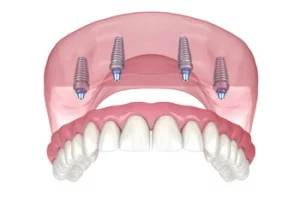 There are two main types:
- Removable (implant-retained dentures): These clip onto attachments on the implants. Ball-retained dentures use round attachments that fit into sockets inside the denture. Bar-retained dentures clip onto a thin metal bar that joins the implants. You take them out for cleaning and at night.
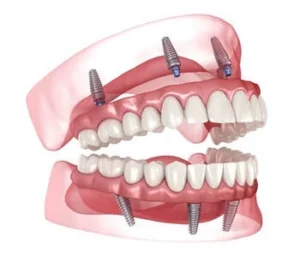
- Fixed: A fixed solution is screwed onto the implants, and only your dentist can remove it. It usually needs more implants and can feel more like fixed teeth, but cleaning underneath takes more care.
A removable lower denture can often be held by fewer implants, sometimes as few as two. The lower jaw is a common starting point because conventional lower dentures tend to move more than upper ones.
How Do They Compare With Conventional Dentures?
Conventional dentures, also called traditional dentures, sit directly on the gum tissue. They have a lower initial cost and need no surgery, which makes them a sensible choice for many patients. Over time, the bone where teeth are missing tends to shrink. This bone loss can make a removable denture loose, and a loose denture may rub and cause gum irritation.
Implants give the denture something to hold onto, which may reduce movement while chewing. The trade-offs are surgery, a longer treatment time and a higher cost. If you still have healthy remaining teeth, a partial denture may also be worth discussing.
What Does the Research Say About Implant-Supported Dentures?
A 2018 systematic review of 26 studies compared conventional complete dentures with lower dentures held by two implants. People with the implant option gave higher ratings for overall satisfaction, comfort, stability, speech and chewing ability, and reported better oral health-related quality of life.
These are average results across groups of people. Individual outcomes vary and depend on your bone, gums, general health and how well the denture is maintained.
What Affects Treatment With Implant-Supported Dentures?
- Jawbone volume: If the bone has thinned, bone grafting or other additional procedures may be needed before implant placement, which adds time.
- Gum health: Active gum disease usually needs to be treated first.
- Remaining teeth: Teeth that cannot be saved may need dental extractions before implants are placed.
- General health: Smoking, diabetes or another medical condition can affect healing, so let your dentist know about your health and any medicines you take.
- Cost: The cost depends on the number of implants, the type of denture and whether extra procedures are needed. We explain the costs involved before any treatment begins.
What Happens During Treatment?
Treatment usually happens in stages over several months:
- Consultation: Your dentist checks your mouth, takes X-rays and talks through your options.
- Implant placement: The implants are placed in the jawbone during minor surgery. Some swelling and tenderness for a few days is common.
- Healing period: Bone takes around three months to grow around an implant, and in some cases the wait is closer to three to six months. A temporary denture can usually be worn during this time.
- Final denture: The attachments are connected, the final denture is fitted, and your bite is checked.
How to Care for Implant-Supported Dentures
 Proper care helps protect the implants and the gums around them.
- Clean removable dentures every day with a soft-bristled toothbrush, and take them out before bed.
- Brush gently around each implant and along your gums, as plaque can still build up there.
- Expect the clips to wear over time. They can usually be replaced without making a new denture.
- Keep up regular check-ups and preventative care, so your dentist can check the implants, the fit and your bite.
- Book a visit if your denture feels loose, your gums bleed, or you notice a sore spot.
A Considered Approach to Implant Supported Dentures
Choosing how to replace missing teeth is a personal decision, and there is rarely one right answer. Our experienced team will look at your jawbone, gums and goals, then talk you through implant-supported dentures alongside other options, including conventional dentures. You can also read more about dental implants at Dental 266.
Dental 266 is open seven days across two Burwood locations, and our team speaks English, Mandarin and Cantonese. If you would like to find out whether implant-supported dentures may suit you, call us on 02 9051 0600.
Note: Any surgical or invasive procedure carries risks. Before proceeding, you should seek a second opinion from an appropriately qualified health practitioner.
Frequently Asked Questions
Are implant-supported dentures removable?
They can be either. Implant-retained dentures clip onto the implants, and you remove them for cleaning. Fixed versions are screwed in place, and only your dentist can take them out.
How many implants do you need for implant-supported dentures?
It depends on your jaw and the type of denture. A removable lower denture is often held by two implants, while fixed options usually need more. Your dentist will recommend a number after checking your bone.
How long does it take to get implant-supported dentures?
Most people need several months from the first visit to the final denture. Healing after implant placement is typically around three to six months, and bone grafting can add more time.
Can I get implant-supported dentures if I have bone loss?
Possibly. Some people have enough bone for implants, while others may need bone grafting first. X-rays and an assessment will show what is suitable in your situation.
How much do implant-supported dentures cost?
The cost varies with the number of implants, the denture type and any additional procedures. They usually cost more than conventional dentures upfront. Your dentist can give you a written treatment plan with costs after a consultation.
References
- Kutkut A, Bertoli E, Frazer R, Pinto-Sinai G, Fuentealba Hidalgo R, Studts J. A systematic review of studies comparing conventional complete denture and implant retained overdenture. Journal of Prosthodontic Research. 2018;62(1):1-9. doi:10.1016/j.jpor.2017.06.004. https://pubmed.ncbi.nlm.nih.gov/28666845/
- Healthdirect Australia. Dental implant procedure. Last reviewed February 2025. https://www.healthdirect.gov.au/dental-implant
- Healthdirect Australia. Dentures. healthdirect. https://www.healthdirect.gov.au/procedures/dental-procedures-and-appliances/dentures