
Some soreness, swelling and mild bleeding are expected after a dental bone graft. Knowing the signs of a failed dental bone graft can help you tell normal healing apart from a problem that needs a check-up.
At Dental 266, we plan bone grafts around a careful assessment of your jaw, health history and treatment goals, and we explain what to expect at each stage.
Quick Overview
- A dental bone graft adds bone or graft material to the jaw, often to support dental implants, but how the graft site heals can vary from person to person.
- Most grafts heal as planned, though some people notice symptoms that do not follow the usual recovery pattern.
- Pain, swelling or bleeding that gets worse instead of better is often what prompts a closer look.
- Smoking, gum disease, oral hygiene and blood supply can all influence how well new bone forms.
- What you notice day to day, and what your dentist sees on review, usually guides the next steps.
Below, we explain what normal healing looks like, the warning signs to watch for, and what may happen if a graft does not take.
What Is a Dental Bone Graft?
A dental bone graft is a surgical procedure that rebuilds lost bone in the jaw. It is a common procedure before dental implants, because an implant needs enough bone volume to hold it in place.
Bone loss can follow tooth loss, tooth extraction, advanced gum disease or injury. Without a tooth root, the surrounding bone may shrink over time.
The graft acts like scaffolding. Over several months, your body grows new bone into it. Graft material may be your own bone, donor bone, animal-derived bone or synthetic (alloplastic) grafts. Your own bone is often seen as the benchmark, while donor, animal and synthetic materials avoid a second surgical site but may heal at a different pace. Learn more about bone grafting for dental implants.
What Is Normal After Dental Bone Graft Surgery?
Some discomfort, swelling, bruising and mild bleeding are normal for the first few days after dental bone graft surgery. These usually ease steadily over one to two weeks. A failing graft tends to show the opposite pattern: symptoms that linger or get worse.
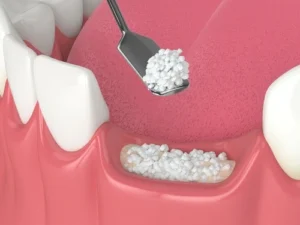 In the first week, you may notice:
- Minor inflammation around the surgical site
- Light oozing of blood for the first day or so
- Tenderness when chewing near the area
- A few small, sand-like granules in your mouth
Swelling often peaks around day two or three. Stitches are commonly removed after about a week, and most people manage with standard pain relief, according to hospital guidance on minor bone grafting.
Our guide to dental bone graft healing stages walks through the full timeline.
What Are the Signs of a Failed Dental Bone Graft?
The main signs of a failed dental bone graft are pain that worsens after the first few days, swelling that does not settle, pus or a bad taste, persistent bleeding, gum pulling away from the area, and exposed graft material. Later, an X-ray may show that not enough new bone has formed.
Persistent pain. Soreness should fade each day. Severe pain or throbbing pain that starts or returns after day three or four can point to infection.
Swelling that grows. Swelling that keeps increasing, or returns after settling, is worth checking.
Pus or a bad taste. These are common signs of infection at the graft site, sometimes with a fever.
Excessive bleeding. Bleeding that does not slow with firm pressure, or starts again days later, is not typical.
Exposed material. If the gum opens and you can see white or grey material, the graft may be exposed to bacteria.
Ongoing loss of granules. A few granules are normal. A steady loss over several days may mean the graft is not staying in place.
Gum recession or movement. Gum tissue shrinking back over the area, or a block graft that feels loose, can suggest the graft is not holding.
Some failures cause no symptoms at all and only show on a scan before implant placement.
People often search for “bone graft rejection”. True immune rejection is uncommon. Most graft failure comes from infection, exposure, movement or poor blood supply.
What Does the Research Say About Dental Bone Graft Failure?
Complications after a bone graft procedure are not rare, though many are minor and manageable. A 2026 systematic review of 100 studies on bone regeneration in the upper jaw reported pooled complication rates of:
- About 8% for sinus lifts
- About 20% for onlay (block) grafts
- About 26% for guided bone regeneration
The most frequent problems were graft or membrane exposure, wound breakdown and infection, the same warning signs listed above. A complication does not always mean the graft is lost. Many can be treated, and the graft may still support an implant. Individual outcomes vary.
What Affects Whether a Bone Graft Heals Properly?
A graft needs good blood flow, a clean environment and stability while new bone forms. Common risk factors include:
- Smoking and vaping. Smoking reduces oxygen reaching healing tissue, and failure risk is higher in people who smoke. One study of onlay grafts and sinus lifts found smokers had more major complications after onlay grafts.
- Poor oral hygiene. Plaque near the surgical site raises infection risk.
- Gum disease. Untreated gum disease can spread bacteria to the graft. Gum inflammation affects around 1 in 4 Australians.
- Poor blood supply. New bone relies on blood vessels growing into the graft. Thin gum tissue, scarring or large grafts can make this harder.
- Pressure. Chewing on the area, or a denture rubbing on it, can disturb the graft.
- General health. Poorly controlled diabetes and some medicines may slow bone healing.
- Graft size and site. Larger grafts, and those near the sinus cavities, carry different risks to small socket grafts.
What Happens If a Dental Bone Graft Fails?
If a dental bone graft fails, your dentist will examine the area and take an X-ray. Treatment depends on the cause and may involve cleaning the site, antibiotics, removing loose material, or repeat grafting once the area has healed.
A graft does not always fail completely. Sometimes enough natural bone forms to proceed, perhaps with a smaller top-up graft during implant placement. If most of the graft is lost, additional grafting procedures may be planned, or other restorative treatments such as a bridge or denture may be discussed instead of implant therapy.
Grafts usually need around three to six months to heal before an implant, so a repeat graft can extend treatment. Early intervention can help avoid further complications. Read about dental implant failure to see how it differs.
How to Look After Your Graft Site
Your dentist will give instructions specific to your procedure. General tips include:
- Follow rinsing and brushing advice. You may need to avoid brushing the graft site for about a week.
- Maintain excellent oral hygiene everywhere else.
- Avoid smoking, vaping and alcohol while healing.
- Eat soft foods and chew on the other side.
- Avoid blowing your nose hard after a sinus lift.
- Keep all review appointments.
Contact your dentist promptly if you have worsening pain, a fever over 38°C, swelling that will not go down, pus, or a lot of bleeding. These are common warning signs after oral surgery. If bleeding is heavy and will not stop with pressure, seek urgent care.
A Considered Approach to Dental Bone Grafts
 Most dental bone grafts heal without major problems, but no surgical procedure is free of risk. Knowing what is normal helps you act early if something changes.
If something does not feel right after a graft, or you’d like to explore whether a bone graft may be suitable before implants, we welcome you to call Dental 266.
Call Dental 266: 02 9051 0600
You can also contact us online or book an appointment online.
Frequently Asked Questions
What are the signs of a failed dental bone graft?
Common signs include pain or swelling that worsens after the first few days, pus, ongoing bleeding and exposed graft material. Gum recession or a loose graft can also be signs. Some failures only show on an X-ray.
How do I know if my bone graft is healing properly?
Healing is usually on track when pain and swelling ease a little each day, and the gum closes over within a couple of weeks. Your dentist confirms bone growth with an X-ray before implant placement.
Is it normal for bone graft granules to come out?
Losing a few small granules in the first week is common. If particles keep coming out over several days, contact your dentist.
Can a failed bone graft be redone?
Often, yes. The area usually needs to heal first, then repeat grafting can be planned. The approach depends on why the first graft failed and how much bone remains.
How long does a dental bone graft take to heal?
The gum usually heals within two weeks. The bone typically needs around three to six months, sometimes longer for larger grafts.
References
- Gaudimier, Z., Tawfik, S., Kerouanton, C., Wulfman, C., et al. (2026). Oral bone regeneration and associated complications: A systematic review and meta-analysis. Journal of Stomatology, Oral and Maxillofacial Surgery, 127, 102606. https://doi.org/10.1016/j.jormas.2025.102606
- Levin, L., Herzberg, R., Dolev, E., & Schwartz-Arad, D. (2004). Smoking and complications of onlay bone grafts and sinus lift operations. International Journal of Oral and Maxillofacial Implants, 19(3), 369-373. https://pubmed.ncbi.nlm.nih.gov/15214220/
- Nicolae, C.-L., Pîrvulescu, D.-C., Niculescu, A.-G., Epistatu, D., Mihaiescu, D. E., Antohi, A. M., Grumezescu, A. M., & Croitoru, G.-A. (2024). An up-to-date review of materials science advances in bone grafting for oral and maxillofacial pathology. Materials, 17(19), 4782. https://doi.org/10.3390/ma17194782
- Guy’s and St Thomas’ NHS Foundation Trust. (n.d.). Bone grafting for dental implants. https://www.guysandstthomas.nhs.uk/health-information/bone-grafting-dental-implants
- Guy’s and St Thomas’ NHS Foundation Trust. (n.d.). Minor bone grafting. https://www.guysandstthomas.nhs.uk/health-information/bone-grafting-dental-implants/minor-bone-grafting
- Australian Dental Association. (2024). Dental Health Week 2024 #1: Bleeding gums are a red flag. https://ada.org.au/dental-health-week-2024-1-bleeding-gums-are-a-red-flag
- Healthdirect Australia. (n.d.). Tooth extraction. https://www.healthdirect.gov.au/tooth-extraction